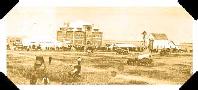
About the year 1750 the Comanche Indians were
pushed south from their home in Eastern
Colorado by their neighbors, the Sioux. Many of them
drifted down into the Panhandle region, where they remained until about 1875.
When the white man began to invade Texas, the Indians were driven out of the more southern and
eastern parts of the state and they took refuge in the northern and western
parts. Then as the pioneers drifted to the Panhandle, the Indians were again
forced to find new hunting grounds. The Plains Indians did not give up easily.
Many battles were fought before the United States troops conquered them and sent them to reservations.

More Swisher County History
|
Swisher County, Texas lies in the Panhandle of
Texas. It is a land of beautiful blue skies, extraordinary sunsets of
many colors, fabulous sunrises and gorgeous harvest moons. The beauty of
the sky, the sunsets, sunrises and harvest moons are best viewed here because
the horizon is unobstructed and seems to go forever. It has a
beauty all of its own - this flat, windswept land.
The first settlers were
no doubt the buffaloes and Indians even though evidence has been found that Coronado and his Spanish forces crossed the
area in search of the mythical cities of gold in 1541. Perhaps
conquistadors thought they had found what they were looking for when they came
upon the Tule Canyon.
In 1883, Charles
Goodnight expanded his now famous J.A. ranch partnership into Swisher County. He built the first log cabin
east of the present town of Tulia to be used as a line camp and
headquarters for his new Tule Ranch. Early settlers sometimes found
seasonal employment on Goodnight’s ranch operation. It was a hard life on
these plains for those first settlers.
December 1886 brought
Mr. J. H. Parrish to land in Swisher and he was the first actual settler in Swisher County. Soon thereafter, in 1887,
the T. A. Gray family and the W. G. Connor family settled in the county.
W. G. Connor built a dugout which was the first home in Tulia.
In 1890 Swisher County was formally organized. The town of
Tulia (named for the Middle Tule Creek)
was chosen as the County Seat. Tulia was nicknamed the “Windmill City” as every house had a windmill. The
commissioner’s court immediately advertised for bids on a courthouse to be
built of “fine lumber”. The first courthouse completed in September
1890 was a two story pine structure. It was used until 1909 when a brick,
three story structure, topped by a dome with four clocks was completed.
In 1962, a fire damaged the courthouse and it was remodeled. The upper
story and the dome were removed and two new wings were constructed. This
change to the beloved courthouse structure was so opposed by old timers that
none of the commissioners on the court at that time were re-elected. The town
grew around the courthouse square and stretched west to the railroad tracks.
The population of Tulia began to grow and the town withstood the Great
Depression and the World Wars. The decades of the 50’s and 60’s became a
prosperous time for farmers and ranchers as water was abundant.
Happy, Texas, located on the Swisher-Randall
county line 16 miles north of Tulia, became an incorporated town in 1925.
The history of Happy began long before the town was incorporated. The
Happy Station was one of the stopping points on the freighting route from Amarillo to Lubbock and beyond. Life for early
settlers in Happy was always full of cattle as the town section was leased by
J. M. McNaughton who grazed 400 cattle on the native grass. The cattle
were allowed to roam the town section in the yards of early day
settlers. Occasionally, the cattle even brought Santa Fe locomotives to a halt as they
meandered across the tracks in the township. The first home built in Happy was
in 1891. It was reportedly the only home between the city of Canyon and Tulia. Eventually
Happy became a town with many merchants and a skyline of its own with grain
elevators along the railroad tracks and Highway 87. Happy, Texas, is now known nationally and
internationally as truly “The Town Without A Frown.”
Swisher County changed
dramatically when the railroad came through the county in 1906. The town
of Wright was moved to meet the railroad and
was renamed Kress by the railroad officials. Kress is about twelve miles
to the south of the county seat of Tulia. One of the first stores built
in Kress was the Wood Mercantile Company. It sold to Mr. J. C. Bagley in
a couple of years and Mr. Bagley also operated a livery stable. Kress
flourished with the building of the school in 1907 and a hotel in
1908. The town and countryside had become fairly well populated and
an outstanding rodeo had been established. A grain elevator was also
built in 1915. It was not until 1955 that Kress was actually incorporated
as a town. Kress, like Happy and Tulia, also has its
own sky line of modern day grain elevators along the railroad tracks and
highway which are a landmark for all who travel through this area.
Tulia, Happy, and
Kress, the towns of Swisher County, and the community of Vigo Park have somehow survived the
years and our hope for the future is never ending. Swisher County, Texas,
pioneers were a hearty lot who withstood many hardships to live on these plains
that were only a sea of buffalo grass stretching as far as one could see, big
skies, “blue northern”, rattlesnakes, prairie dogs and Indians.
|